
The Stuart Brightline Station: Who Pays, and When?

If you want to understand how infrastructure actually gets built in Florida, follow the Brightline Treasure Coast station. It is a case study, and it is happening in your county.
The timeline, plainly
Brightline announced on March 4, 2024 that Stuart had won the bid for its Treasure Coast station, on a 2.35-acre site in historic downtown Stuart in Martin County. The company had run a competitive process; Fort Pierce submitted multiple proposals and lost.
The original public timeline was construction in 2026, opening in 2028. Earlier statements had suggested an opening by the end of 2026.
Then the project ran into the things projects run into.
As of August 2026, reporting indicates the station remains unbuilt and faces three obstacles: opposition from Florida East Coast Railway, which owns the rail corridor Brightline uses and which earlier in 2026 announced it does not support a passenger station in Stuart, citing operational concerns; a missed federal grant opportunity; and unresolved questions about taxpayer cost. Martin County has been seeking federal assistance, and county leadership states it remains committed.
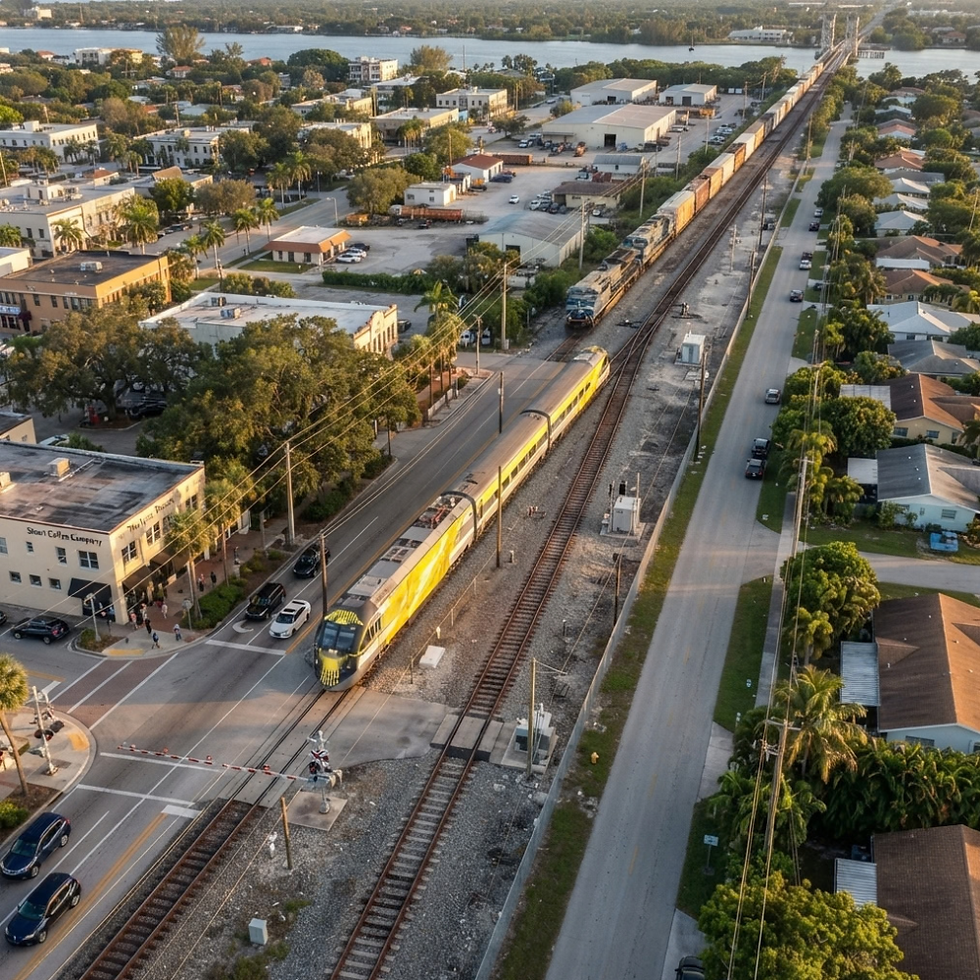
Meanwhile, Treasure Coast residents who want to ride Brightline still drive roughly 45 minutes south to West Palm Beach, while the trains pass through their counties daily.
Why the railroad's objection is the one that matters
Of the three obstacles, funding is solvable and politics is negotiable. The corridor owner's position is structural.
Brightline operates on track owned by Florida East Coast Railway, a freight operator. A passenger station is not a neutral addition to a freight corridor. It introduces dwell time, platform infrastructure and scheduling constraints onto a line engineered for freight throughput.
When the corridor owner says a station creates operational concerns, that is not a bargaining posture to be dismissed. It is the party that controls the physical asset describing a conflict with its core business.
This is the single most underreported element of the story and it is the one I would weigh most heavily.
The business case, both directions
The case for the station: direct rail access connects Treasure Coast residents to Miami, Fort Lauderdale, West Palm Beach and Orlando without driving. Downtown Stuart businesses gain visitor traffic arriving on foot rather than looking for parking. Station-adjacent property values in other Brightline markets have responded, and transit access is a recruitment argument for employers trying to attract workers who cannot afford South Florida housing. For a region whose workforce increasingly commutes south, that is not a small thing.
The case against: the public contribution is real money with a real opportunity cost, in counties with substantial competing infrastructure obligations including wastewater and lagoon restoration. Martin County in particular has a long history of rail opposition and legitimate concerns about grade crossings, emergency response times and the character of a downtown that many residents chose precisely because it is not Fort Lauderdale. And a station that depends on a corridor owner's cooperation is a station with execution risk that a cost-benefit model does not easily price.
Both of those are serious positions held by serious people in your community. I am not going to tell you which one is right.
The part that is actually about your money

Three practical implications, regardless of where you land.
If you own property near the proposed site or near a plausible alternative: the development premium on station proximity is real in other Brightline markets, and it is speculative here until the project is certain. Do not pay a station premium for a station that does not exist. If you already own, understand that you are holding an option, not an asset with a confirmed value.
If you run a downtown Stuart business: plan for two scenarios. Station traffic is a different customer than current foot traffic, arriving at different hours, with different spending patterns. The businesses that benefit most in other markets prepared before the opening, not after.
If you are a taxpayer in Martin or St. Lucie County: the question to put to your commission is specific. Not "do you support the station." Ask: what is the county's maximum financial exposure, what triggers it, and what happens to that money if the corridor owner does not agree. A commissioner who can answer that has read the agreement. One who answers with enthusiasm has not.
And Fort Pierce is still standing there
The St. Lucie County angle persists. Fort Pierce leadership has repeatedly indicated interest in reopening a conversation if the Stuart arrangement fails. Fort Pierce last had passenger rail service in 1968.
That is not idle. If the Stuart project stalls permanently, the regional economic development question moves twenty miles north, and the Treasure Coast's transit-oriented development future relocates with it.
What to watch
Three signals, in order of importance. Any resolution between Brightline and Florida East Coast Railway. Any federal funding award. Any formal action by the City of Stuart or Martin County that commits or withdraws money.
Press releases are not signals. Signed agreements are.
This is general information about a public infrastructure matter, not investment or legal advice. Consult a Florida-licensed professional about your own situation.
One question for your county commission: what is our maximum financial exposure on this station, what triggers it, and what happens to that money if the railroad does not agree? We will publish the answers we get.
Sources notes:
March 4, 2024 announcement, 2.35-acre downtown Stuart site: [FACT] [R18]
Construction 2026 / opening 2028: [FACT] as the stated plan at that time [R19]
FEC Railway opposition, missed federal grant, taxpayer cost questions, 45-minute drive to West Palm Beach, Fort Pierce interest: [FACT] as of August 2026 reporting [R17]
Current status: [LIVE] must be confirmed before publication
Corridor-owner analysis and the "option not an asset" framing: author's analysis, explicitly labelled
Property value effects in other Brightline markets: stated directionally with no figure, because I do not have a verified Treasure Coast figure and will not invent one



Comments