
Half the "Farmers" at Your Farmers Market Didn't Grow a Thing

I love a farmers market. I love the tote bags, the dog situation, the guy with the honey, the whole ritual. I am the target demographic and I am not ashamed.
I am also going to ruin it for you slightly, because October is coming and you deserve to spend your money well.
Here's the thing about Florida: our growing season is upside down. While the rest of the country is closing up shop, we're just getting started — roughly October through May is when Florida field produce actually happens. July tomatoes on the Treasure Coast did not come from a Treasure Coast field. They came from a truck.
Which brings us to the uncomfortable part.
The reseller problem
At a lot of markets — not all, but a lot — a meaningful share of the produce vendors are not farmers. They're retailers. They buy at a wholesale produce terminal, load a van, set up a folding table, add a chalkboard sign with a nice font, and sell you the same Guatemalan bananas and Mexican avocados you'd get at Publix, at a markup, in a canvas tent, next to a person playing acoustic guitar.
This is not illegal. At many markets it isn't even against the rules. But it is a different transaction than the one you think you're making.
You came to a farmers market for three reasons, whether or not you'd say them out loud: fresher food, food dollars staying local, and a relationship with the person who grew it. A reseller delivers exactly none of those. You paid a premium for ambience.
I'm not saying every vendor is faking it. I'm saying the market won't tell you which is which. You have to ask.
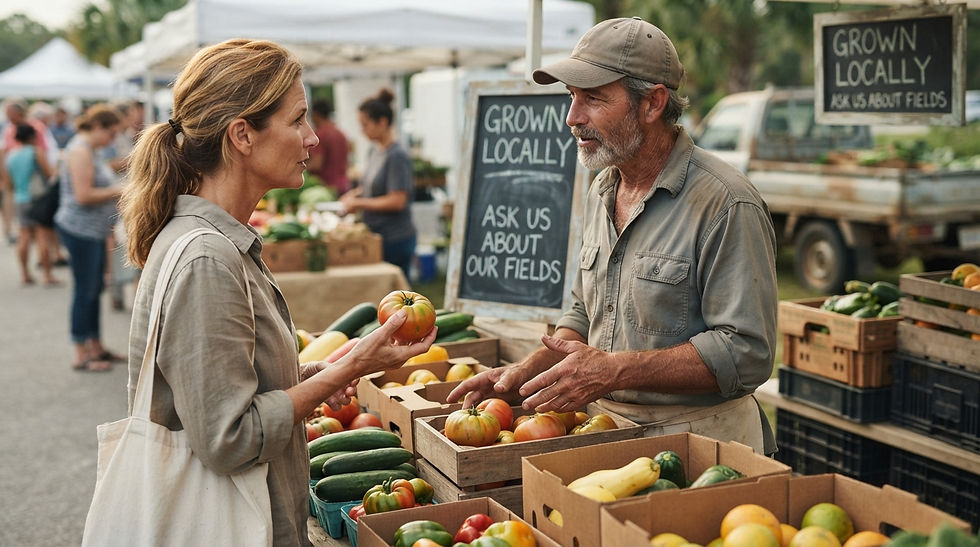
The four questions that sort it out in ninety seconds
None of these are hostile. Real growers love these questions. Watch the face, not just the answer.
1. "Where's your farm?" A grower gives you a road, a town, an acreage. "Out west" and "up north a ways" are not answers. Real farmers are specific about land because land is the entire business.
2. "What'd you pick this week?" Growers talk about this week constantly, because this week is their whole life. They'll tell you what came in heavy, what got hit, what's two weeks out. A reseller talks about what they have.
3. "What's not going to be here next month?" Seasonality is the tell. Somebody who grows things knows exactly what's ending, because they're already worried about it. Somebody who buys things can get anything, anytime, and their table looks like it.
4. "Can I come see it?" The gold standard. Most working farms can't host drop-ins and will say so — but a real grower will offer something: a u-pick weekend, a CSA, a farm store, an event. A reseller changes the subject.
What's actually in season here, and when
Bookmark this. Rough Treasure Coast/South Florida windows:
October–November: the season opens. Green beans, cucumbers, squash, eggplant, peppers, early leafy greens, herbs.
December–February: peak. Tomatoes, strawberries, sweet corn, cabbage, broccoli, radishes, and citrus — Indian River citrus is a genuine regional distinction, not marketing.
March–May: the sweet spot before the heat. Mangoes coming in late spring, sweet corn, tomatoes hanging on, avocados starting.
June–September: the hard months. Local field produce largely stops. What's genuinely local now is seafood, eggs, honey, mushrooms, microgreens, and hydroponic or greenhouse operations.
Notice that last line. In summer, the honest local market is a protein-and-pantry market, not a produce market. Vendors who insist otherwise are telling on themselves.
Does "local" actually make it healthier?
Let me be straight with you rather than sell you something.
Produce does lose some nutrient content after harvest, particularly water-soluble vitamins, and particularly over long transit and storage. So yes, a green bean picked Thursday and sold Saturday has a modest edge over one that spent ten days in a cold chain. But the effect is real and moderate, not miraculous. Anyone promising you a nutritional transformation from switching to local is overselling.
The bigger, better-supported benefit is behavioral, and I'd argue it matters more. People who shop markets eat more vegetables. They cook more. They eat more variety, because the market forces variety on you — you buy what's there, not what's on the list. They waste less, because they paid attention to it. Those habits move health outcomes far more than the vitamin C differential in a single bean.
So the case for local produce is strong. It's just a different case than the one on the chalkboard.

Spend it better
Three moves for the season opening this month:
Pick one market and become a regular at one table. Recognition changes everything. You'll get told what's good before it hits the table, and you'll get the honest "skip that this week."
Buy the ugly one. Same nutrition, better price, and it's often better-tasting because it wasn't bred for shipping durability.
Ask about a CSA or farm box now. Season's starting. The good ones fill.
The market is worth your Saturday. Just make sure the person taking your money grew the thing.



Comments